Summary
Background
Cecolin, a bivalent human papillomavirus (2vHPV) vaccine produced with Escherichia coli, has demonstrated safety and efficacy and is now widely used globally. We aimed to report the efficacy, safety, and immunogenicity profile of the nine-valent (9vHPV) vaccine, Cecolin 9.
Methods
We conducted a multicentre, double-blind, randomised, controlled, phase 3 trial at five local health centres in the Jiangsu and Sichuan provinces in China. Eligible participants were healthy, non-pregnant women aged 18–45 years with an intact cervix, no previous HPV vaccination, and between one and four lifetime sexual partners. Participants were stratified by age (18–29 and 30–45 years) and randomly assigned (1:1) with an interactive web response system (central randomisation with block sizes of eight) to receive three doses of either the 9vHPV vaccine (vaccine group) or the 2vHPV vaccine (control group) at day 0, month 1, and month 6. All participants, investigators, and laboratory personnel were masked to group assignment. The coprimary outcomes were immunogenicity, defined as non-inferiority of neutralising antibodies against HPV 16 and 18 at month 7 in the per-protocol set, and persistent infection (≥12 months), associated with HPV 31, 33, 45, 52, and 58 in the modified intention-to-treat population. Non-inferiority was identified for the lower limit of the 95% CI of the geometric mean concentration (GMC) ratio (9vHPV vs 2vHPV) at a margin of 0·5 and a seroconversion rate difference (9vHPV – 2vHPV) at a margin of –5%. Both criteria had to be met to establish non-inferiority. This trial is registered with ClinicalTrials.gov (NCT04537156) and follow-up is ongoing.
Findings
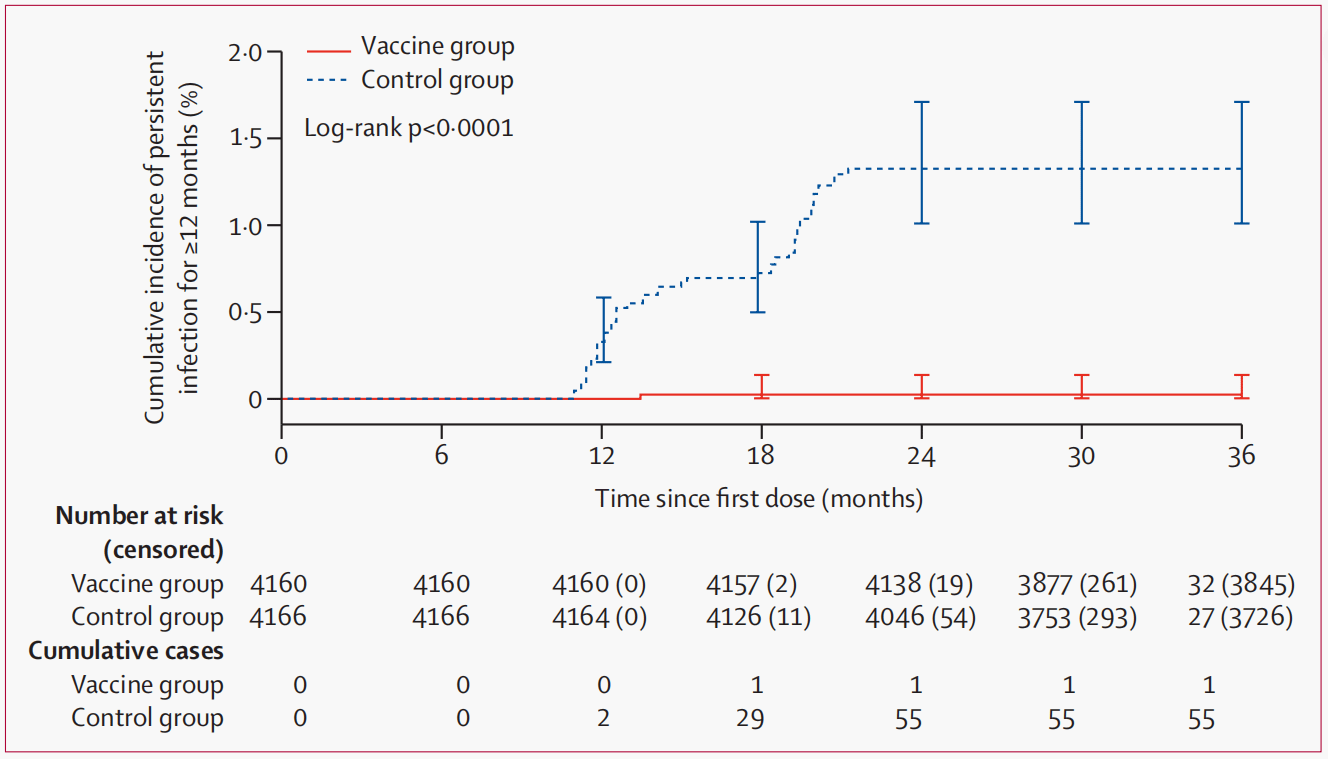
Between Sept 5 and Dec 10, 2020, 11 024 individuals were screened, of whom 9327 (84·6%) eligible women were randomly assigned to the vaccine group (4663 [50·0%]) and the control group (4664 [50·0%]). In the per-protocol set, antibody responses against HPV 16 and 18 in the vaccine group were non-inferior to those in the control group. The GMC ratio was 0·60 (95% CI 0·56–0·66) for HPV 16 and 0·64 (0·58–0·70) for HPV 18; the difference in seroconversion rates was 0·0% (95% CI –0·49 to 0·48) for HPV 16 and –0·12% (–0·67 to 0·33) for HPV 18. In the modified intention-to-treat population, 9vHPV vaccine efficacy against 12-month persistent infection associated with HPV types 31, 33, 45, 52, and 58 was 98·2% (95% CI 89·6–100). Adverse reactions were reported by 2432 (52·1%) of 4664 participants in the vaccine group and by 1966 (42·2%) of 4663 in the control group. Serious adverse events occurred at a similar rate between the vaccine group (512 [11·0%]) and the control group (481 [10·3%]); none were considered related to vaccination.
Interpretation
The E coli-produced 9vHPV vaccine was well tolerated, immunogenic, and highly protective against vaccine-targeted HPV types. Given its low production cost, this vaccine has the potential to improve global access to high-valency HPV vaccination.
Funding
National Key R&D Program of China, National Natural Science Foundation of China, Natural Science Foundation of Beijing Municipality, Natural Science Foundation of Xiamen Municipality, Fundamental Research Funds for the Central Universities, and Xiamen Innovax.
Translation
For the Chinese translation of the abstract see Supplementary Materials section.
Paper link: https://www.thelancet.com/journals/laninf/article/PIIS1473-3099(26)00221-5/fulltext
Review link: https://www.thelancet.com/journals/laninf/article/PIIS1473-3099(26)00256-2/fulltext