Abstract
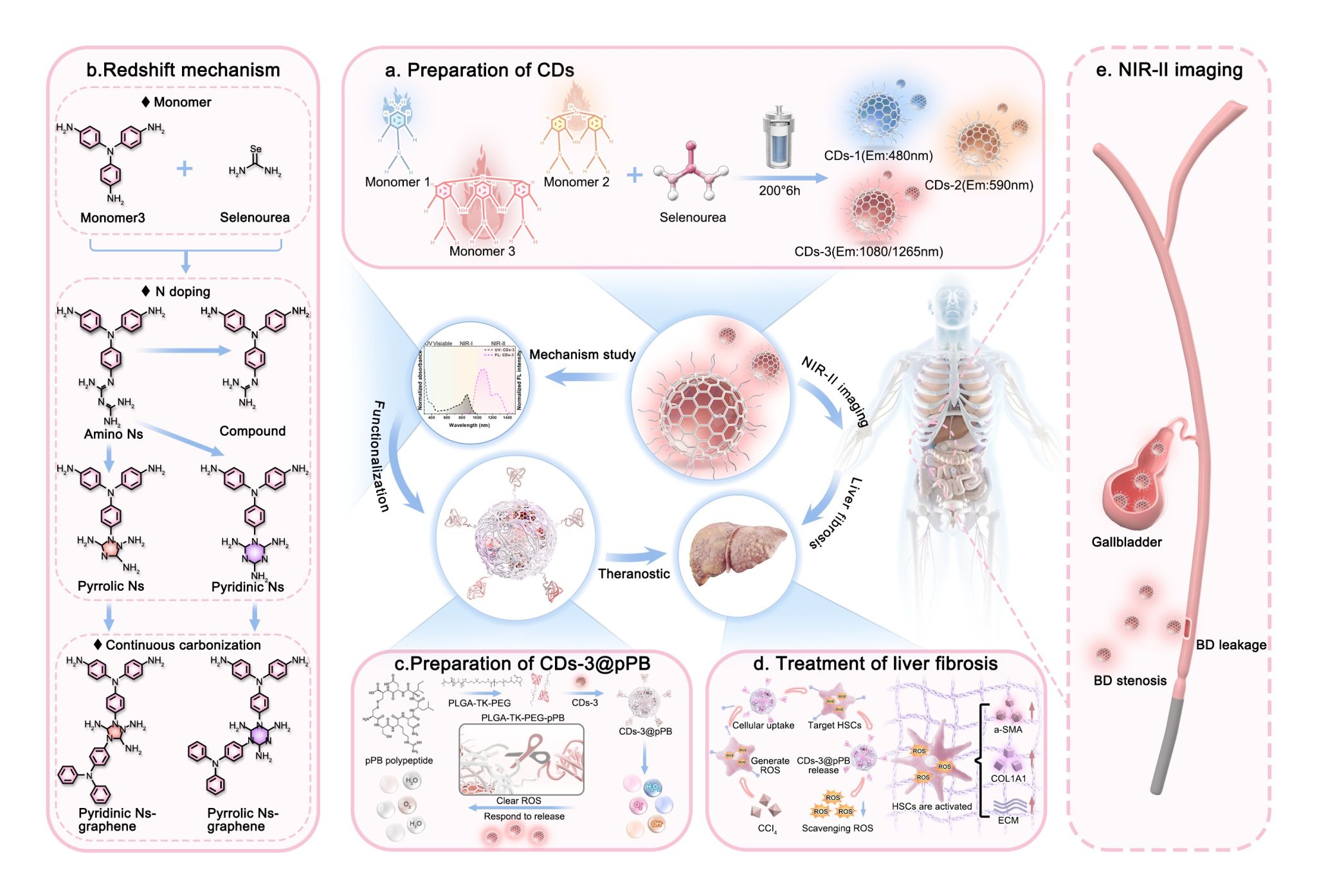
Near-infrared-II carbon dots offer exceptional deep-tissue penetration for biomedical imaging, but challenges remain in their synthesis and photoluminescence mechanisms. Here, we report three carbon dots (CDs-1, CDs-2, CDs-3) with tunable emission from the visible to the Near-infrared-II (480–1265 nm), synthesized by constructing extended aniline-based frameworks from p-phenylenediamine. Combined structural and density functional theory analyses reveal that the Near-infrared-II redshift arises from the enhanced molecular dipole moments and electron-acceptor ability of the precursor, as well as the accumulation of graphene domains and pyrrolic nitrogen doping during carbonization polymerization, which collectively drive the narrowing of the energy gap. CDs-3 shows 15 mm penetration depth in gallbladder Near-infrared-II imaging (vs. clinically used indocyanine green 2 mm). With 1.44 signal-to-noise ratio and 334.5 μm resolution, it enables precise monitoring of biliary strictures/leakage. Selenium-doping-derived functionalized composite nanomaterials (CDs-3@pPB) exhibit potent reactive oxygen species scavenging and theranostic efficacy in liver fibrosis. This work elucidates the mechanism underlying the redshift of carbon dots emission into the Near-infrared-II and establishes a nanoplatform for hepatobiliary theranostics, demonstrating substantial clinical potential.
Link:https://www.nature.com/articles/s41467-026-70150-7